

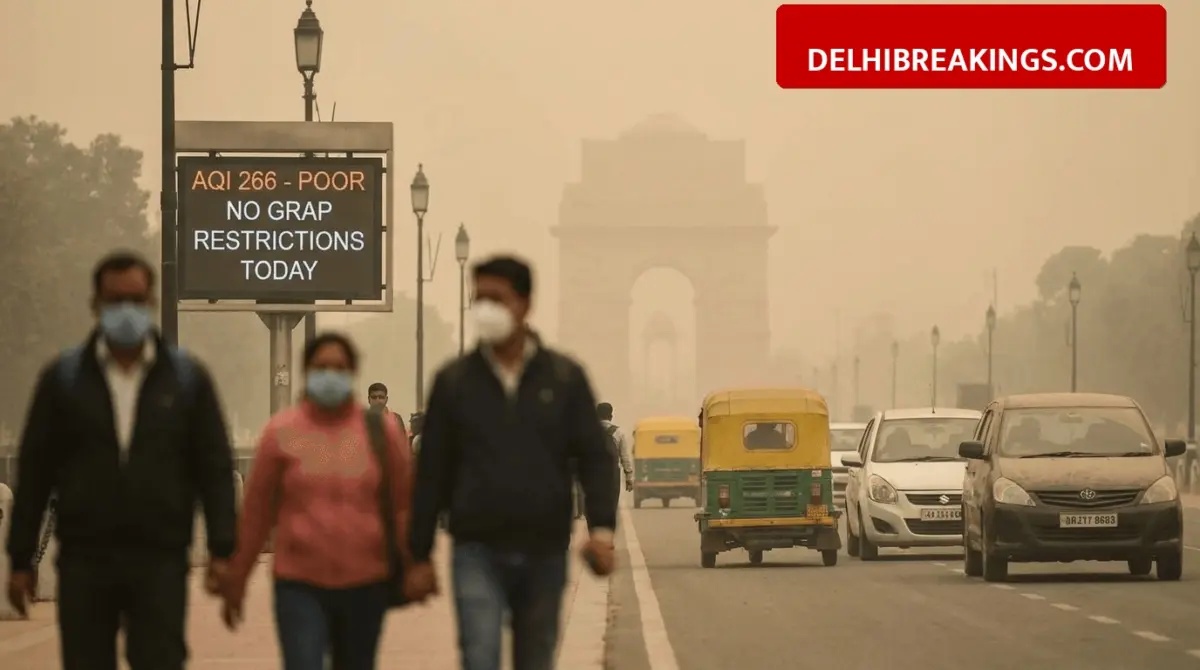
Delhi and its neighboring regions witnessed a significant dip in air quality on Thursday, April 2, 2026. A morning dust storm pushed the Air Quality Index (AQI) to 266, which falls into the ‘poor’ category. Despite the sudden increase in pollution levels, the Commission for Air Quality Management (CAQM) has announced that no additional restrictions under the Graded Response Action Plan (GRAP) will be implemented for now.
Why did the CAQM decide against GRAP restrictions?
The decision was taken after a comprehensive review of the current air quality scenario and meteorological forecasts. Data from the India Meteorological Department (IMD) and the Indian Institute of Tropical Meteorology (IITM) indicated that the spike was primarily due to a localized dust storm. Experts suggest that the overall AQI is likely to remain in the ‘moderate’ category in the coming days as weather conditions improve. The CAQM sub-committee believes that current measures are sufficient and there is no immediate need to move to emergency protocols.
Understanding the different stages of GRAP
The Graded Response Action Plan is an emergency mechanism used to control pollution levels in the National Capital Region. The actions are categorized into four stages based on the severity of the air quality. Here is a breakdown of the specific AQI ranges and the corresponding measures:
- Stage I (Poor): AQI between 201 and 300. Includes enforcing NGT and Supreme Court orders on overaged vehicles.
- Stage II (Very Poor): AQI between 301 and 400. Involves water sprinkling on roads and regulating diesel generators.
- Stage III (Severe): AQI between 401 and 450. Restricts BS III petrol and BS IV diesel 4-wheelers and shifts primary schools to hybrid mode.
- Stage IV (Severe Plus): AQI above 450. Can lead to school closures for all classes and the introduction of odd-even vehicle rules.
The CAQM remains the primary statutory body responsible for monitoring these levels and taking necessary actions. While the AQI reached the Stage I threshold today, the forecast for a quick recovery played a key role in the decision to hold back on new restrictions. Citizens are advised to stay informed through official updates from the Central Pollution Control Board (CPCB).
