

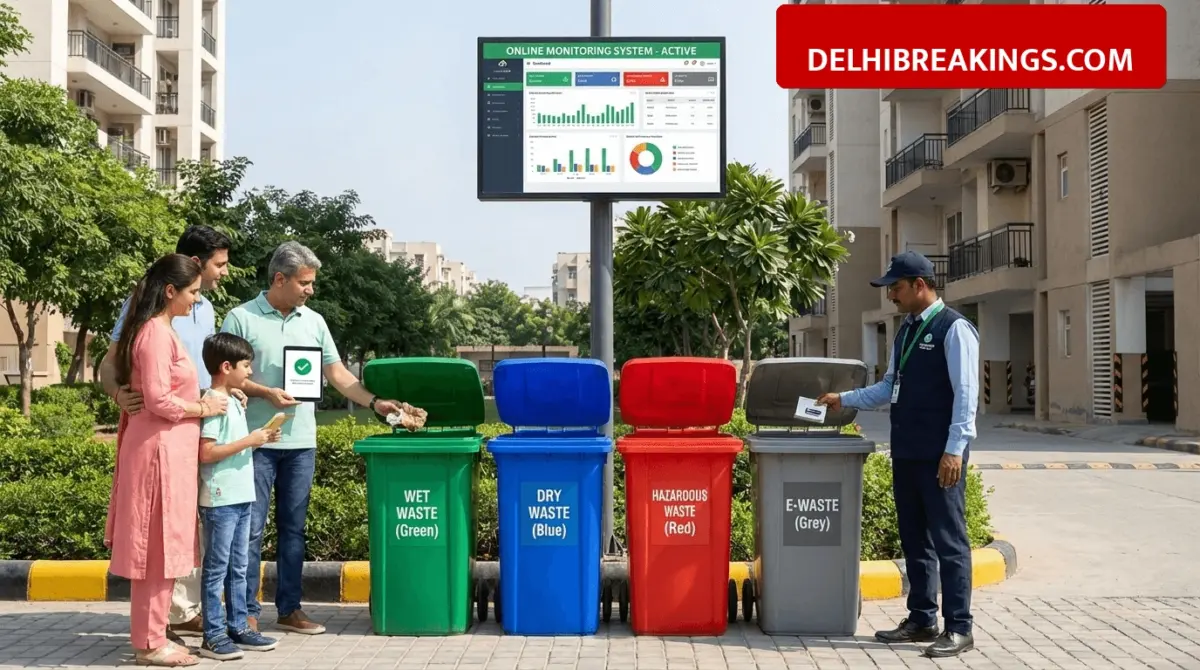
The Solid Waste Management (SWM) Rules, 2026, officially came into effect on April 1, 2026, bringing a major shift in how Delhi and the National Capital Region handle garbage. This new law, notified by the Union Ministry of Environment, Forest and Climate Change, replaces the decade-old regulations of 2016. The updated framework focuses on digital tracking and mandatory waste processing, making it mandatory for residents and businesses to join a centralized system designed to monitor waste collection and disposal in real-time.
What are the Mandatory Segregation and Collection Rules?
The 2026 rules require every household and commercial unit to separate their waste into four distinct streams: wet, dry, sanitary, and special care waste. To support this, the Municipal Corporation of Delhi (MCD) has launched an alternate-day collection plan. Under this schedule, wet waste is picked up on Monday, Wednesday, Friday, and Sunday. Dry waste collection happens on Tuesday, Thursday, and Saturday. The government is also considering property tax rebates for colonies that show high levels of compliance with source segregation to encourage public participation.
Stricter Guidelines for Hotels, Hospitals, and Societies
Establishments generating over 100 kg of waste per day or occupying more than 20,000 sq.m are now categorized as Bulk Waste Generators (BWGs). These entities, including hotels and hospitals, must process their organic waste on-site or use authorized agencies. All BWGs are required to register on the Centralised Online Portal and maintain digital records of their waste treatment. Failure to comply can result in heavy monetary penalties, environmental compensation, and the cancellation of trade licenses, as authorities aim for 100% processing within the next year.
Key Features of the SWM Rules 2026
The new framework introduces several technical and administrative changes to ensure accountability at every level of waste management. Below are the primary features of the new policy:
| Feature | Details |
|---|---|
| Effective Date | April 1, 2026 |
| Online Tracking | Centralised Online Portal for all waste stages |
| RDF Usage | Industries must increase RDF use from 5% to 15% |
| Polluter Pays | Environmental compensation for false data or no registration |
| Waste Pickers | Provisions for formal registration and social security |
| Mandatory Audits | All processing facilities must upload audit reports online |
